Showing posts with label circadian. Show all posts

Tuesday, April 23, 2013

Jet Lag - are you LAGGING behind?

Know the real term - Desynchronosis

Jet lag is a chronobiological-related problem, similar to issues often induced by shift work. When traveling across a number of time zones, the body clock will be out of synchronization with the destination time, as it experiences daylight and darkness contrary to the rhythms to which it has grown accustomed: the body's natural pattern is upset, as the rhythms that dictate times for eating, sleeping, hormone regulation and body temperature variations no longer correspond to the environment nor to each other in some cases. To the degree that the body cannot immediately realign these rhythms, it is jet lagged.
The speed at which the body adjusts to the new schedule depends on the individual; some people may require several days to adjust to a new time zone, while others experience little disruption. Crossing one or two time zones does not typically cause jet lag.
The condition is not linked to the length of flight, but to the trans-meridian (west–east) distance traveled. A ten-hour flight from Europe to southern Africa does not cause jet lag, as travel is primarily north–south. A five-hour flight from the east to the west coast of the United States may well result in jet lag.
Crossing the International Date Line does not contribute to jet lag, as the guide for calculating jet lag is the number of time zones crossed, and the maximum possible disruption is plus or minus 12 hours. If the time difference between two locations is greater than 12 hours, subtract that number from 24. Note, for example, that the time zone GMT+14 will be at the same time of day as GMT−10, though the former is one day ahead of the latter.
Common Symptoms of Jet Lag are
  • Headaches
  • Fatigue, irregular sleep patterns, insomnia
  • Disorientation, grogginess, irritability
  • Mild depression
  • Constipation or diarrhea
See the picture below :
Matt Kursmark designed this infographic series about circadian rhythms and What Causes Jet Lag as an assignment in his information graphics class at Ohio State University.


Tuesday, April 3, 2012

Managing Jet Lag... Simple interesting solutions...


Before the flight


Attempt to partially adapt to the destination time zone in advance. This includes starting the daily routine one hour before or after one normally does during the week before departure. The use of a light box might help speed up the body's body clock adjustment significantly.
Light therapy or phototherapy (classically referred to as heliotherapy) consists of exposure to daylight or to specific wavelengths of light using lasers, light-emitting diodes, fluorescent lamps,dichroic lamps or very bright, full-spectrum light, usually controlled with various devices. The light is administered for a prescribed amount of time and, in some cases, at a specific time of day.

During the flight

One option to counteract jet lag is to break the trip into smaller segments if it is too long and stay overnight in some city. Additionally, it may be advisable to adjust sleeping hours on the plane to match the destination time.

Upon arrival

A helpful way to minimize jet lag is to adapt to the local time and eat accordingly. Also, exposure to sunlight during the day is helpful.

There seems to be some evidence that for most people, traveling west to east is more disruptive. This may be because most people have a circadian period which is a bit longer than 24 hours, making it easier to stay up later than to get up earlier

Gradual adjustment over the course of several days of the onset of sleep while maintaining its regular length of 7–8 hours can reduce fatigue and prevent depression. When the goal is to catch-up with local time (vs. fallback to), this can be aided by avoiding afternoon naps and eating an early and carbohydrates-rich, low-protein dinner.
Melatonin
A 2005 study showed that melatonin was effective in helping people fall asleep at doses of 0.3 milligrams (mg). Then, to treat the jet lag, the recommended dose of melatonin is 0.3–0.5 mg, to be taken the first day of traveling. Administration of higher doses can cause sleepiness, lethargy, confusion, and decreased mental sharpness

Fasting

A 2008 animal study suggested that lack of food helps to override the light-controlled circadian body clock. One of its authors suggested in a statement that "a period of fasting with no food at all for about 16 hours is enough to engage this new clock. The neat thing about this second clock is that it can override the main clock and you should just flip into that new time zone in one day". One approach to implement this would be to eat nothing on the plane and fast until it is breakfast time at the destination

Viagra

A recent study in hamsters showed that sildenafil citrate (known commercially as Viagra) aided in a 50% faster recovery from shifts comparable to eastward travel experienced by humans and was effective starting at low doses. However, this use has not been tested in humans and is considered an off-label use by the drug's manufacturers.


Sunday, April 1, 2012

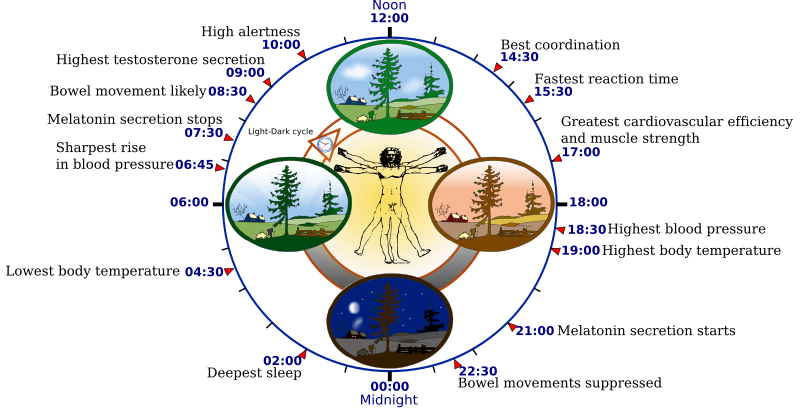
Circadian rhythm - What to do and When to do it BEST?

A circadian rhythm is any biological process which displays an endogenous, entrainable oscillation of about 24 hours. 
(Entrainment means that within the study of chronobiology, occurs when rhythmic physiological or behavioral events match their period and phase to that of an environmental oscillation) 


These rhythms are driven by (or composed of) a circadian clock, and rhythms have been widely observed in plants, animals, fungi and cyanobacteria. 


The term circadian comes from the Latin circa, meaning "around" (or "approximately"), and diem or dies, meaning "day". 
The formal study of biological temporal rhythms, such as daily, tidal, weekly, seasonal, and annual rhythms, is called chronobiology. 
Although circadian rhythms are endogenous ("built-in", self-sustained), they are adjusted (entrained) to the local environment by external cues called zeitgebers, commonly the most important of which is daylight.


Some features of the human circadian biological clock


ONCE THIS is understood - you will understand JET LAG better - Tomorrow!

Saturday, March 31, 2012

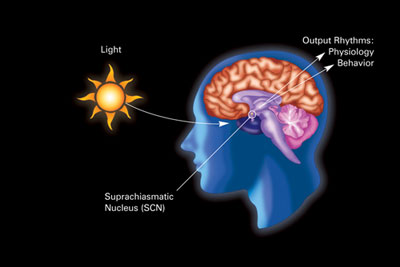
Circadian Clock - The body's time keeper


A circadian clock, or circadian oscillator, is a biochemical mechanism that oscillates with a period of 24 hours and is coordinated with the day-night cycle. Circadian clocks are the central mechanisms which drive circadian rhythms. They consist of three major components:
  1. A central oscillator with a period of about 24 hours that keeps time
  2. A series of input pathways to this central oscillator to allow entrainment of the clock
  3. A series of output pathways tied to distinct phases of the oscillator that regulate overt rhythms in biochemistry, physiology, and behavior throughout the organism
The clock is reset as the environment changes through an organism's ability to sense external time cues of which the primary one is light. Circadian oscillators are ubiquitous in tissues of the body where they are synchronized by both endogenous and external signals to regulate transcriptional activity throughout the day in a tissue-specific manner 

To be called circadian, a biological rhythm must meet these four general criteria:
  1. The rhythms repeat once a day (they have a 24-hour period). 
  2. The rhythms persist in the absence of external cues (endogenous). 
  3. The rhythms can be adjusted to match the local time (entrainable). 
  4. The rhythms maintain circadian periodicity over a range of physiological temperatures; they exhibit temperature compensation. 

Tomorrow we will talk about Circadian rhythm and JET LAG