Showing posts with label pediatric endocrinology. Show all posts

Sunday, February 19, 2012

LINGUAL THYROID

The tongue is the most frequent ectopic location of the thyroid gland. Incidence of lingual thyroid varies between 1:3000 and 1:10,000.
Picture Courtesy: http://www.ghorayeb.com/LingualThyroid.html


In the first month of life the anlage of the thyroid gland descends from the posterior dorsal midline of the tongue to its final position in the lower neck. The initial site of descent eventually becomes the foramen caecum, located in the midline at the junction of the anterior (oral) tongue and the tongue base. 
If the embryonic gland does not descent normally, ectopic or residual thyroid tissue may be found between the foramen caecum and the epiglottis.
Rarely, parathyroid glands can be associated with the ectopic thyroid.  Many patients with lingual thyroid lack thyroid tissue in the neck.


Surgical excision or radioiodine therapy can be effective treatments for lingual thyroid, but no treatment should be attempted before radioisotope scan has confirmed that there is adequate thyroid tissue in the neck.  In those patients lacking thyroid tissue in the neck, the lingual thyroid could be excised and auto-transplanted in the neck region. 
Most cases require no treatment.
Keeping TSH and Free T4 in a good range will avoid undue enlargement which can sometime result in respiratory distress

Saturday, February 18, 2012

Gila Monster and GLP!

Gila monster is the only venomous lizard native to the United States and one of only two known species of venomous lizards in North America


Venom is produced in modified salivary glands in the Gila monster's lower jaw, unlike snakes, whose venom is produced in the upper jaw. 
In 2005,  drug exenatide was approved (marketed as Byetta) for the management of type 2 diabetes. It is a synthetic version of a protein, exendin-4, derived from the Gila monster's saliva.
Exenatide led to healthy sustained glucose levels and progressive weight loss. The effectiveness is due to the fact that exenatide is about 50 percent identical to glucagon-like peptide-1 analog (GLP-1), a hormone released from the human digestive tract that helps to regulate insulin and glucagon. The lizard protein remains effective much longer than the human hormone, helping diabetics keep their blood sugar levels under control. 
Exenatide slows the emptying of the stomach and causes a decrease in appetite, contributing to weight loss.
The saliva of the Gila monster contains many chemicals which can be deadly. One of these has been shown to affect memory. Several companies have been researching the abilities of this chemical to help memory loss due to various diseases such as Alzheimer’s, schizophrenia, and ADHD. Gilatide, derived from exendin-4, has been shown to dramatically heighten memory in a study with mice. Gilatide is likely to be researched further to provide help to Alzheimer’s patients.
Source: Wikipedia

Friday, February 17, 2012

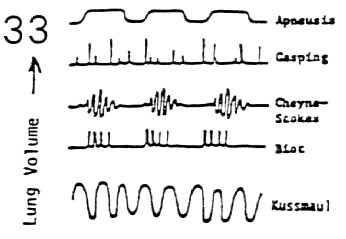
Kussmaul Breathing

Kussmaul breathing is a deep and labored breathing pattern often associated with severe metabolic acidosis, particularly diabetic ketoacidosis (DKA) but also renal failure. It is a form of hyperventilation, which is any breathing pattern that reduces carbon dioxide in the blood due to increased rate or depth of respiration. 

Kussmaul breathing is respiratory compensation for a metabolic acidosis, most commonly occurring in diabetics in diabetic ketoacidosis. Blood gases on a patient with Kussmaul breathing will show a low partial pressure of CO2 in conjunction with low bicarbonate because of a forced increased respiration (blowing off the carbon dioxide). Base excess is severely negative. The patient feels an urge to breathe deeply, an "air hunger", and it appears almost involuntary.
A metabolic acidosis soon produces hyperventilation, but at first it will tend to be rapid and relatively shallow. Kussmaul breathing develops as the acidosis grows more severe. Indeed, Kussmaul originally identified this type of breathing as a sign of coma and imminent death in diabetic patients.
Duration of fasting, presence or absence of hepatomegaly and Kussmaul breathing provide clues to the differential diagnosis of hyperglycemia in the inborn errors of metabolism
Content courtesy: Wikipedia, Patterns of breathing: Loyola University Medical Education Network. Video from Youtube

Tuesday, February 14, 2012

Thyroid Antibodies


Thyroid peroxidase or thyroperoxidase (TPO) is an enzyme expressed mainly in the thyroid that liberates iodine for addition onto tyrosine residues on thyroglobulin for the production of thyroxine (T4) ortriiodothyronine (T3), thyroid hormones. In humans, thyroperoxidase is encoded by the TPO gene.
Thyroid peroxidase is a frequent epitope of autoantibodies in autoimmune thyroid disease, with such antibodies being called anti-thyroid peroxidase antibodies (anti-TPO antibodies).


THYROID ANTIBODYACRONYMPRESENT INWHEN ORDEREDOTHER FACTS
Thyroid peroxidase antibodyTPOAbHashimoto thyroiditis;Graves diseaseWhen patient has symptoms suggesting hypothyroidism; when considering starting a patient on a drug therapy that has associated risks of developing hypothyroidism when thyroid peroxidase antibodies are present, such as lithium, amiodarone, interferon alpha, or interleukin-2Has been associated with reproductive difficulties, such as miscarriage,preeclampsia, premature delivery, and in-vitro fertilization failure
Thyroglobulin antibodyTgAbThyroid cancer; Hashimoto thyroiditisWhenever a thyroglobulin test is performed to see if the antibody is present and likely to be interfering with the test results; since the thyroglobulin test will be ordered at regular intervals after thyroid cancer treatment, thyroglobulin antibody will also be ordered at regular intervals 
Thyroid stimulating hormone receptor antibodyTRAbGraves diseaseWhen patient has symptoms of hyperthyroidism; to monitor effectiveness of anti-thyroid therapy 

Wednesday, February 8, 2012

Neonatal Diabetes


Disease characteristics. Permanent neonatal diabetes mellitus (PNDM) is characterized by the onset of hyperglycemia within the first six months of life (mean age: 7 weeks; range: birth to 26 weeks) that does not resolve over time. Clinical manifestations at the time of diagnosis include intrauterine growth retardation (IUGR); hyperglycemia, glycosuria, osmotic polyuria, severe dehydration, and failure to thrive.


Approximately 20% of individuals with mutations in KCNJ11 have associated neurologic findings, called the DEND syndrome (developmental delay, epilepsy, and neonatal diabetes mellitus)


a milder form without seizures and with less severe developmental delay is called intermediate DEND syndrome


Pancreatic hypoplasia caused by homozygous PDX1 mutations results in severe insulin deficiency and exocrine pancreatic insufficiency.


Management. Treatment of manifestations: Start rehydration and intravenous insulin 


The five genes currently known to be associated with nonsyndromic PNDM (Autosomal Dominant) are KCNJ11(~30% of PNDM), ABCC8 (~19%), INS (~20%), GCK (~4%), and PDX1 (<1%). Molecular genetic testing is available on a clinical basis for all genes
Some Autosomal Recessive Mutations also exist
Prenatal counselling needs to be done in affected families


Courtesy: http://www.ncbi.nlm.nih.gov/books/NBK1447/


Image courtesy: http://diabetes.diabetesjournals.org/content/57/11/2889.full

.